Description
Here's What Mooer Say About the Envelope Analogue Auto Wah
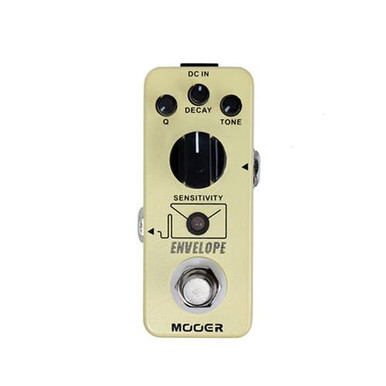
The 'Envelope' from MOOER is a pocket sized 'envelope filter'/'dynamic auto wah' pedal with big tone and lots of versatility.The sensitivity control allows you to dial in the effect to respond to the dynamics of your playing and the pickups of any instrument in the way you want it to.Exaggerated slap back funk, subtle sultry abience, static frequency filter effects and many more are all easily obtainable with this little pedal.The 100% analog circuit provides a lush warm sound and the wide range of the controls make the Envelope from MOOER ideal for use with both guitar and bass.
Controls
Sensitivity: The sensitivity control adjusts the dynamic response of the envelope filter in relation to the input from the instrument. Clockwise makes the pedal more sensitive and responsive to pick attack and makes it easier to open the filter. Counter clockwise makes the pedal less sensitive to pick attack and makes it more difficult to open the filter.Note: Sensitivity is set differently depending on which guitar pickups you use and what the desired response from the pedal is of the user. Recommended starting position is 12 o'clock and adjust from there accordingly
Q: This control changes the Q of the wah effect. Clockwise will make the Q value higher providing a more narrow frequency band but a higher peak.This results in a very exaggerated and pronounced wah sound. Counterclockwise will lower the Q value, providing a wider frequency band and a lower peak. This results in a more subtle wah effect.
Decay: The Decay Control adjusts the release and closing of the filter. Clockwise gives a longer decay and counterclockwise gives a shorter decay.
Note: This is also dependant on the sensitivity settings and the attack of the instrument.
Tone: The tone control adjusts the overall tone and frequency range of the pedal. Clockwise will give a brighter tone and a higher frequency range.Counterclockwise will give a rounder tone and a lower frequency range. Counterclockwise is perfect for using with a bass guitar.Note: When the 'SENSITIVITY' is set to 0 the 'TONE' control can be used as a static frequency filter.
Specifications
- Input: 1/4” mono audio jack.(Impedance: 1Meg Ohms)
- Output: 1/4” mono audio jack(Impedance: 1k Ohms)
- Power requirements: AC adapter 9V DC , center negative. Highly
- Recommend to use Mooer Micro Power.
- Current Draw: 20mA
- Dimensions: 93.5mm(D) x 42mm(W) x 52mm(H)