About the manufacturer
Boss is a Japanese company founded in 1973 and is one of the most respected names in the world of guitar effects and amplification. Known for their compact stompbox pedals, Boss has defined the sound of countless musicians with classics like the DS-1 Distortion, CE-2 Chorus, and DD-3 Delay. Their range now includes multi-effects processors, loop stations, amplifiers, and recording tools, all built with the brand’s trademark durability and reliability. Favoured by beginners and professionals alike, Boss products are a staple on pedalboards across the UK, offering dependable performance and iconic tone shaping for every style of music.
More info about this Product
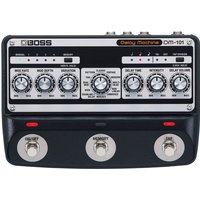
Delay records the incoming signal for a chosen interval and repeats it after the original note. Feedback returns repeats to the delay line, while tone, filtering, modulation and saturation determine whether echoes remain clear, darken progressively, wobble like tape or degrade like analogue bucket-brigade circuits. Delay time and rhythmic subdivisions govern the spacing and musical pattern of the repeats.
Guitar pedals are compact effects units that shape and enhance a guitar’s sound, sitting between the instrument and the amplifier. They include gain pedals like overdrive and distortion, modulation effects such as chorus and tremolo, time-based effects like delay and reverb, and essential utilities including tuners, compressors and loopers. Understanding basic things such as pedal type, signal order, power requirements and intended use helps players choose pedals that suit their style, setup and playing environment.
More Gear like this
Analogue equipment uses continuous electrical signals rather than digital processing to shape and produce sound. In music gear, analogue circuits are found in pedals, amplifiers, and effects that rely on physical components such as transistors, valves, resistors, and capacitors.
Analogue sound is often described as warm, organic, and responsive, with natural saturation and subtle imperfections that react to playing dynamics. It is valued for its feel and character, particularly in overdrive, fuzz, modulation, and classic effects where musical interaction is more important than precision.
Delay is an effect that records the guitar signal and plays it back after a short period of time, creating an echo or repeat. By adjusting the time, feedback, and level, delay can add subtle depth and space or produce rhythmic, expressive repeats that enhance lead lines, ambient textures, and overall atmosphere.
Guitar pedals alter, route, control or support an instrument signal from the floor. The tag covers individual effects, multi-effects, switching, tuning, looping, amplification and pedalboard utilities. The product category and additional effect tags identify the specific job each pedal performs.
Stereo refers to an audio setup that uses two separate channels, left and right, to create a sense of width, space, and direction in sound. By sending slightly different signals to each channel, stereo allows effects and instruments to feel more immersive and three-dimensional compared to a single mono signal.
In guitar and audio equipment, stereo is commonly used with delays, reverbs, modulation effects, and multi-amp rigs to enhance depth and movement. Stereo setups can make a sound feel wider and more spacious, especially in recording or live environments where separation between speakers can be clearly heard.