29 Pedals OAMP Output Amplifier Pedal

£309.00

The 29 Guitar Pedals always come out on top. This is New is in stock and ready to post out to you, with fast, reliable delivery straight to your door. For more New Guitar Pedals options, read on for full specifications, demos, and secure online ordering. Here's what 29 Pedals say about the OAMP It’s pronounced w-amp! OAMP is an output driver designed to replace a conventional output buffer or gain pedal at the end of your chain. If you’re familiar with EUNA, it’s a similar concept but with a few key differences. High headroom, clean gain, great drive capability. They…

More Details

View more in
Tags: , ,
View more by

As an affiliate partner, we may earn a small commission when you buy through our links — at no extra cost to you.


Description

The 29 Guitar Pedals always come out on top. This is New is in stock and ready to post out to you, with fast, reliable delivery straight to your door. For more New Guitar Pedals options, read on for full specifications, demos, and secure online ordering.

Here's what 29 Pedals say about the OAMP

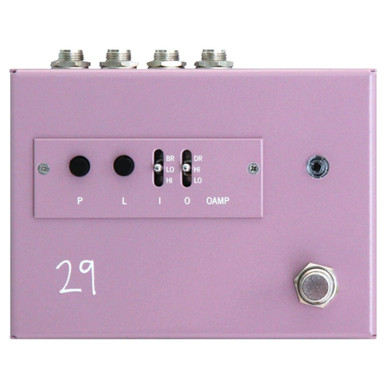
It’s pronounced w-amp! OAMP is an output driver designed to replace a conventional output buffer or gain pedal at the end of your chain. If you’re familiar with EUNA, it’s a similar concept but with a few key differences. High headroom, clean gain, great drive capability. They key features are labelled below. There are subtle tonal variations in the gain settings. Maximum clean output level is 20dB. 29dB of gain available. OAMP makes enough gain to drive your amp into breakup without adding it’s own distortion, or you can use it to trim hot signals from your pedalboard. The insert loop is active when OAMP is OFF, so you can easily swap from clean drive to a dirt pedal, alternative preamp or anything you want really. With nothing plugged into the insert OAMP is True-Bypass when switched off.

Controls

  • P – Presence –  At fully clockwise there is a gentle shape to the tone – dial it back to add a subtle mid-scoop to the sound similar to an amplifier tone stack.
  • L – Level – A trim control between the two gain stages. With both gain stages at low and Presence at full, gain is about 6dB. With both gain stages at high, gain is about 29dB.
  • I – Input gain stage – Settings for High, Low and Bright. Bright adds top-end to the Low setting. This stage is before the Level fader.
  • O – Output gain stage – Settings for Low, High and Dark. Dark cuts top-end from the High setting. This stage is after the level fader.

Additional information

Weight 1 kg

Stuff About Guitar Pedals

Guitar pedals are compact effects units that shape and enhance a guitar’s sound, sitting between the instrument and the amplifier. They include gain pedals like overdrive and distortion, modulation effects such as chorus and tremolo, time-based effects like delay and reverb, and essential utilities including tuners, compressors and loopers. Understanding basic things such as pedal type, signal order, power requirements and intended use helps players choose pedals that suit their style, setup and playing environment.

The Important stuff

Amplifier. Pedal — Pedals are the tools that let you shape, colour and transform your sound, from subtle tone enhancement to bold, creative effects. Whether you are adding grit, space, movement or control, a pedal becomes part of your playing rather than just an add-on. Exploring different pedals is about discovering what responds to your touch and helps your sound feel more like your own.. Pedals — Pedals are compact effects units placed between a guitar and an amplifier to shape, enhance, or transform your sound. They cover everything from drive and distortion to modulation, delay, reverb, and dynamics, allowing players to build a personalised tone and respond creatively to different musical styles and playing situations..