Description
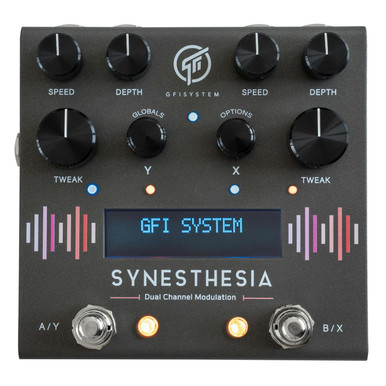
GFI System are renowned for their digital time-based pedals, most notably the powerful Specular Reverb and Clockwork Delay. The Synesthesia, however, represents GFI System's first foray into the world of modulation.
With a flexible dual-channel design allowing you to use two effects simultaneously in parallel (Mixtures), series (Cascade) or stereo (LR-Split), you can of course use any of the GFI System Synesthesia's 30 algorithms as standalone effects too. Boasting MIDI connectivity, 32 preset slots and other powerful modern features — the GFI System Synesthesia does more than simply embellish your core amp tones!
Key Features
- Dual-engine, multi-modulation processor in a compact pedal
- 32 presets
- 30 algorithms
- Flexible DSP Routing: Cascade, Mixtures and LR Split
- Flexible Modes: Preset and Stompbox
- Flexible Setup: Stereo Output or Pre/Post
- Multi-Purpose A.C.E jack accepts Aux Switches, Control Voltage (CV) or Expression Pedal
- MIDI In and MIDI Thru
- Works with SymmLab software for preset management, library update, firmware update and factory reset
- Bright LEDs and LCD display
Here's what GFI System says about the Synesthesia Dual Channel Modulation Pedal:
Synesthesia is an advanced, yet user friendly dual-channel multi-modulation engines, capable of running two modulation algorithms simultaneously. Packed with 22 classic and modern algorithms (expandable to 30 with future updates) and 3 different DSP routing schemes Synesthesia offers limitless sonic possibilities.
Synesthesia is not just another modulation pedal. By marrying a powerful dual-engine architecture with rich and deep algorithms, we provide players with immersive and 'colourful' modulation effects experience, hence the name: Synesthesia. Up to 30 on-board algorithms — more will be made accessible via the 'SymmLab' editor.
Amplitude
- Tremolo
- Dynamic Tremolo
- Harmonic Tremolo
- Chopper
- Slow Volume
Filters
- Filter
- Envelope Filter
- Sample & Hold Filter
- Formant
Swirls
- Dimension
- Chorus
- Tri-Chorus
- Detune
- Dyane Flanger
- Tape Flanger
- Sample & Hold Flanger
Phase
- Phaser
- Envelope Phaser
- Sample & Hold Phaser
- Univibe
Miscellaneous
- Octave Shifter
- Vibrato
- Rotary
- Ring Modulator
- Double Tracker
Sequencers
- Arp Tremolo
- Arp Filter
- Arp Formant
- Arp Flanger
- Arp Phaser
- Arp RingMod
- Arpeggiator
Specifications
- Input Impedance: 1 MOhm
- Output Impedance: 500 Ohm
- DAC / ADC Resolution: 24 Bits
- Current Consumption: ~240 mA
- Weight: 0.8 Kg (1.6 lbs)
- Dimensions: 12 (L) x 12 (W) x 5.5 (H) cm
- Power Source: 9VDC (Negative Center)