Description
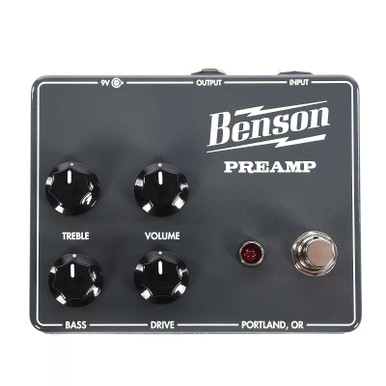
The Benson Guitar Pedals always come out on top. This is New is in stock and ready to post out to you, with fast, reliable delivery straight to your door. For more New Guitar Pedals options, read on for full specifications, demos, and secure online ordering.
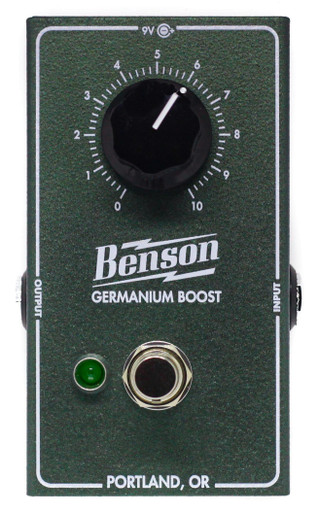
Boost pedals come in many different forms – Some of them cut out your bass frequencies, essentially boosting the treble, while others boost the mid frequencies which can be useful for fattening up lead lines. The Benson Germanium Boost is a linear boost that doesn't affect your EQ. Instead, it preserves your natural tone and sounds just like your guitar and amplifier, only boosted! Housed in a rugged chassis with one simple volume control, the Benson Germanium Boost is a useful tool for giving your solos a much needed lift or pushing your amp into natural overdrive.
Here's what Benson say about the Germanium Boost
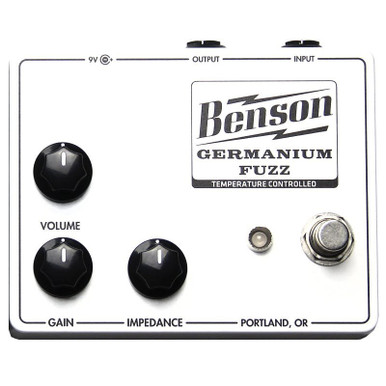
When designing the temperature controlled fuzz, we tried some weird approaches. One of the things we tried was utilizing a voltage controlled error correcting circuit to bias a single germanium transistor. It ultimately didn’t work for the fuzz, since that circuit is comically sensitive to transistor gain attributes. We did find a place for it though.
It turns out it was PERFECT for achieving a germanium clean boost that, (like our fuzz) is impervious to component drift, leakage, and temperature….more so in fact. We also fixed a couple other issues preventing the germanium transistor from being used as a convincing linear boost…we increased the input headroom (even a normal guitar signal will drive a germanium transistor into unwanted input distortion without some tweaks) and increased the input impedance (a BJT transistor would normally thin out bass frequencies and interact negatively with whatever flows into it). The result is a germanium clean boost where you can utilize a germanium transistor WITH- OUT the weird artefacts that were previously accepted as part of the deal…temperature sensitivity, drift, and suboptimal input impedance and headroom.
It takes about 10 seconds when the boost is first powered up for the error correction circuit to bias the germanium transistor. After that it gets interesting….we can hear how it makes guitar signals sound more musical…even when set at the same volume as the bypassed tone. It seems to bring out the attack of the guitar while simultaneously smoothing out notes, like a compressor but different. It’s hard to describe. It appears to cut the bad parts of a signal and enhance the good. It’s killer on bass. It helps acoustic guitar pickups sound more natural. And of course it’ll push your amp into a frenzy.
We hope you like it.
POWER SUPPLY
This pedal is for use only with a 9vdc Boss-style center negative power supply. There is space for a battery which is activated when a cable is plugged into the input, and there is no power supply plugged into the DC jack. Please do not subject this pedal to more than 9vdc or the pedal or power supply could be destroyed.