Description
The Crazy Guitar Pedals always come out on top. This is New is in stock and ready to post out to you, with fast, reliable delivery straight to your door. For more New Guitar Pedals options, read on for full specifications, demos, and secure online ordering.
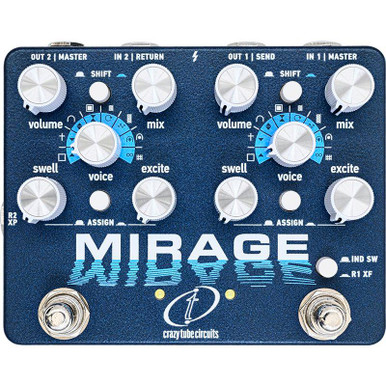
Why settle for one studio-grade dual-engine reverb unit when you could have two! The Crazy Tube Circuits Mirage puts 2 fully independent high-powered studio-grade digital reverb engines working alongside a whole host of flexible mono and stereo routing options, in conjunction with premium components and analogue-dry-through, into one, easy-to-navigate, screen-free box!
Specifications
- 16 Algorithms – The Mirage comes loaded with 16 studio-grade Reverb algorithms covering everything from classic live and studio Reverbs to luscious ambient out-of-this-world soundscapes.
- Flexible Routing – Each Reverb features independent controls, and the Mirage can be run in mono and Stereo as well as fully independent dual mono, mono in series and mono to stereo, enabling you to easily and quickly adapt the Mirage into your existing setup.
- Expressive Footswitch – The Mirage allows you to get even more creative and expressive with your reverb, hands-free and without any additional expression control thanks to its R1 XF control. Engage the XF switch and use the right footswitch as a ramp-up and down control for either Swell or Excite for Reverb 1.
Here’s what Crazy Tube Circuits says about the Mirage…
Mirage – the Master of Reflections by Crazy Tube Circuits is a dual-engine reverb workstation that redefines sonic depth and flexibility. With two fully independent reverb processors (R1 and R2), each offering 16 high-quality algorithms, Mirage can deliver everything from vintage realism to cinematic ambience.
With flexible routing options and autonomous control over each engine, Mirage lets you:
- Run distinct reverbs on the le¬ and right stereo channels.
- Cascade the engines in series for layered, evolving spaces.
- Shape sonic environments that range from subtle and natural to massive and surreal.
Whether dialing in tight spring slapbacks, massive cathedral echoes, or surreal shimmer-scapes with modulation and pitch shifts, Mirage responds intuitively with real-time performance tools like expression pedal control and footswitch-based parameter morphing.
Its send/return loop between engines expands creative possibilities by allowing pedal insertions between reverb stages.
With an analog dry path, studio-grade clarity, and a menu-free user interface, Mirage is as direct as it is deep—equally at home on a pedalboard, in a synth rig, or on a studio desk return.
Mirage puts studio-grade reverb control at your feet – with endless room for creativity.
- Dual independent reverb engines – Dedicated controls per engine for hands-on shaping.
- Flexible routing setup: mono in series, stereo, independent dual mono, or mono to stereo configurations – easily adapts to complex gear rigs or in the studio.
- SEND/RETURN loop between engines – insert pedals between reverb stages for enhanced routing.
- 16 total algorithms split into two intuitive banks: vintage/classic and ambient/experimental.
- Studio-grade signal path with high headroom, clarity, and detail. Analogue-dry signal path.
- Flexible footswitching modes – independent engine toggling or real-time ramp expression.
- Assignable external expression pedal input.
- Internal switches for routing and bypass mode selection.
- Direct, playable interface for instant creative results – no menus to navigate.
- Power supply (not included): Use an isolated 9V DC, 2.1 mm x 5.5 mm, centre negative power supply.
- Max current consumption 210mA.
- Click-less true bypass design via high-quality relay or buffered bypass with reverb trails.
- Power-up bypass/engage preset function for the footswitches.
- Top-mounted jacks.
- Dark Abyss Blue die-cast enclosure.
- Compact, rugged enclosure – designed for road use without sacrificing control layout.
- (W x L x H) : 123 x 97 x 54 mm.
- Weight 457 g.
- Made in Greece