Description
The Lehle Guitar Pedals always come out on top. This is New is in stock and ready to post out to you, with fast, reliable delivery straight to your door. For more New Guitar Pedals options, read on for full specifications, demos, and secure online ordering.
Here’s what Lehle say about the Mono Volume
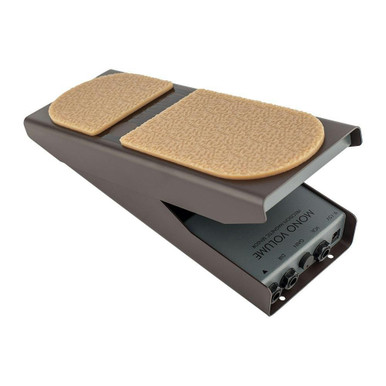
The Lehle Mono Volume is a volume pedal equipped with a precise magnetic sensor enabling it to operate almost wear-free. This sensor uses the Hall effect, named after Edwin Hall, to measure the strength of magnetic fields. In the Lehle Mono Volume the Hall sensor, which is made in Germany, is accurately calibrated to the built-in magnet and the control range of the pedal. The pedal moves only the magnet, the distance is measured by the Hall sensor which controls a VCA.
A premium Blackmer VCA (= Voltage Controlled Amplifier) from the United States replaces here in this case the mechanical potentiometer.
The principle of the voltage-controlled amplifier is based on the fact that gain can be varied by the control voltage coming from the Hall sensor. This technique allows to operate more precisely than conventional mechanical potentiometers or optical sensors used by the standard volume pedals. In addition the potentiometer-typical noise and the complicated adjustment are eliminated.
Over the entire control range the Lehle Mono Volume transmits the full sound spectrum of the connected instrument. The input and output impedance always stay the same, ensuring that there will be no damping of higher frequencies as with potentiometers.
Internally, the input voltage coming from the power supply socket of the pedal is rectified, then filtered, stabilized and doubled to 18V, thus achieving a total dynamic range of 110 dB.
The volume control of the Lehle Mono Volume ranges from -92 dB to 0 dB – so from a virtually muted level to the same volume. With a potentiometer a gain up to +10 dB boost can be additionally adjusted.
The Lehle Mono Volume runs mechanically extremely smooth and steady, as it is equipped with low-friction bearings of a high-performance polymer, and there is no mechanical transmission of the pedal to other components. By means of an adjusting screw the mobility of the pedal can be modified very precisely.
Furthermore, the Lehle Mono Volume has a buffered direct out which can supply a tuner, DAW or a second amp without affecting the sound.
Q: Can the Lehle Mono Volume also be placed in the amp’s effect loop as a master volume control?
A: Due to the high impedance input and low impedance output it is possible to place the Lehle Mono Volume before the amp or in the amp’s effect loop. The effect loop should be serial or if parallel set to 100% wet.
Q: What’s the difference between the Lehle Mono Volume and the Lehle Mono Volume 90?
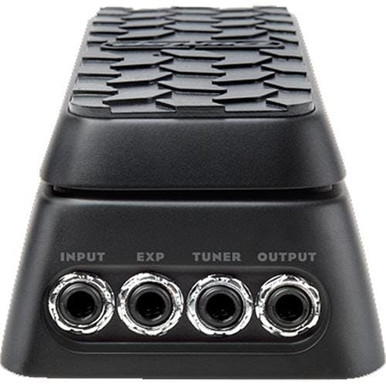
A: The Lehle Mono Volume has the connections at the front, while the Lehle Mono Volume 90 has the connections at the side and an additional control for the minimum volume.
Q: What is the effect of an impedance converter?
A: The sound will be freshened up and signal loss through long cable runs will be compensated.
Q: How can I compensate the signal loss on my effects board?
A: By using an impedance converter, which provides a high impedance input socket for the instrument signal and a low impedance output signal that is more resistent against loss.
Specifications
- Weight: 1,620 g
- Length: 26 cm (10.24‘‘)
- Width: 10 cm (3.94‘‘)
- Overall height: 6.6 cm (2.6‘‘)
- Voltage: 9 – 15 V DC or 7 – 12 V AC
- Power consumption: 50 mA
- Frequency range: 50 Hz – 100 kHz (all controls in middle position)
- THD: < 0,05 % at 1 kHz, -10 dBu
- Impedance input: 2 MOhm
- Impedance output: 500 Ohm
- Signal-to-noise ratio: -102 dB at 1 kHz, 0 dBu A weighted
- (control in “unity gain“ position)
- Max level: 3 V RMS (ca. 12 dBu at 12 V input voltage)
- Gain control (max amplification): +10 dB