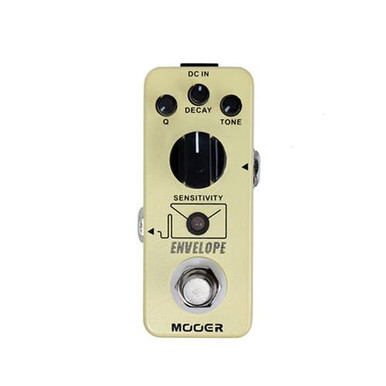
Mooer Envelope Analogue Auto Wah Pedal

Retailing in the region of £59.99

The Mooer Mooer always come out on top. This is New is in stock and ready to post out to you, with fast, reliable delivery straight to your door. For more New Mooer options, read on for full specifications, demos, and secure online ordering. Here's What Mooer Say About the Envelope Analogue Auto Wah The 'Envelope' from MOOER is a pocket sized 'envelope filter'/'dynamic auto wah' pedal with big tone and lots of versatility.The sensitivity control allows you to dial in the effect to respond to the dynamics of your playing and the pickups of any instrument in the way…

View more in
Tags: , , ,
View more by

As an affiliate partner, we may earn a small commission when you buy through our links — at no extra cost to you.


Description

The Mooer Mooer always come out on top. This is New is in stock and ready to post out to you, with fast, reliable delivery straight to your door. For more New Mooer options, read on for full specifications, demos, and secure online ordering.

Here's What Mooer Say About the Envelope Analogue Auto Wah

The 'Envelope' from MOOER is a pocket sized 'envelope filter'/'dynamic auto wah' pedal with big tone and lots of versatility.The sensitivity control allows you to dial in the effect to respond to the dynamics of your playing and the pickups of any instrument in the way you want it to.Exaggerated slap back funk, subtle sultry abience, static frequency filter effects and many more are all easily obtainable with this little pedal.The 100% analog circuit provides a lush warm sound and the wide range of the controls make the Envelope from MOOER ideal for use with both guitar and bass.

Controls

Sensitivity: The sensitivity control adjusts the dynamic response of the envelope filter in relation to the input from the instrument. Clockwise makes the pedal more sensitive and responsive to pick attack and makes it easier to open the filter. Counter clockwise makes the pedal less sensitive to pick attack and makes it more difficult to open the filter.Note: Sensitivity is set differently depending on which guitar pickups you use and what the desired response from the pedal is of the user. Recommended starting position is 12 o'clock and adjust from there accordingly

Q: This control changes the Q of the wah effect. Clockwise will make the Q value higher providing a more narrow frequency band but a higher peak.This results in a very exaggerated and pronounced wah sound. Counterclockwise will lower the Q value, providing a wider frequency band and a lower peak. This results in a more subtle wah effect.

Decay: The Decay Control adjusts the release and closing of the filter. Clockwise gives a longer decay and counterclockwise gives a shorter decay.

Note: This is also dependant on the sensitivity settings and the attack of the instrument.

Tone: The tone control adjusts the overall tone and frequency range of the pedal. Clockwise will give a brighter tone and a higher frequency range.Counterclockwise will give a rounder tone and a lower frequency range. Counterclockwise is perfect for using with a bass guitar.Note: When the 'SENSITIVITY' is set to 0 the 'TONE' control can be used as a static frequency filter.

Specifications

  • Input: 1/4” mono audio jack.(Impedance: 1Meg Ohms)
  • Output: 1/4” mono audio jack(Impedance: 1k Ohms)
  • Power requirements: AC adapter 9V DC , center negative. Highly
  • Recommend to use Mooer Micro Power.
  • Current Draw: 20mA
  • Dimensions: 93.5mm(D) x 42mm(W) x 52mm(H) 
Additional information

Weight 0.5 kg

About the manufacturer

Mooer

Mooer are known for making standout effects pedals and more. Founded with a passion for tone and innovation, their gear has shaped countless records and players’ sounds. Look out for their iconic designs and flagship models — they’ve earned a reputation for reliability and creativity.

More info about this Product

Guitar Pedals

Guitar pedals are compact effects units that shape and enhance a guitar’s sound, sitting between the instrument and the amplifier. They include gain pedals like overdrive and distortion, modulation effects such as chorus and tremolo, time-based effects like delay and reverb, and essential utilities including tuners, compressors and loopers. Understanding basic things such as pedal type, signal order, power requirements and intended use helps players choose pedals that suit their style, setup and playing environment.

More Gear like this

Analogue

Analogue equipment uses continuous electrical signals rather than digital processing to shape and produce sound. In music gear, analogue circuits are found in pedals, amplifiers, and effects that rely on physical components such as transistors, valves, resistors, and capacitors.

Analogue sound is often described as warm, organic, and responsive, with natural saturation and subtle imperfections that react to playing dynamics. It is valued for its feel and character, particularly in overdrive, fuzz, modulation, and classic effects where musical interaction is more important than precision.

Envelope

Envelope effects respond dynamically to how hard or softly you play, shaping the sound based on the input signal rather than a fixed control. The effect opens and closes in real time, creating tonal changes that follow your picking or playing dynamics.

They are most commonly associated with envelope filters and auto-wah effects, producing expressive, vocal-like sweeps that react to touch and groove. Envelope effects are widely used in funk, jam, electronic, and experimental music, where rhythmic feel and player interaction are central to the sound.

Pedal

Pedals are the tools that let you shape, colour and transform your sound, from subtle tone enhancement to bold, creative effects. Whether you are adding grit, space, movement or control, a pedal becomes part of your playing rather than just an add-on. Exploring different pedals is about discovering what responds to your touch and helps your sound feel more like your own.

Wah

Wah pedals are all about expression. By rocking the foot pedal back and forth, you sweep through frequencies to create that classic vocal-like “wah-wah” sound. From funk to rock solos, the wah adds movement, personality, and attitude to your tone. Think Hendrix, Clapton, or Slash — each used a wah to make their guitar sing. Whether you prefer a classic Cry Baby or a modern auto-wah, this effect remains one of the most recognisable sounds in guitar history.

Related gear

Available for Amazon Prime