Description
The Disaster Guitar Pedals always come out on top. This is New is in stock and ready to post out to you, with fast, reliable delivery straight to your door. For more New Guitar Pedals options, read on for full specifications, demos, and secure online ordering.
Please Note: The MIDI Box is a MIDI signal converter only, you cannot use it to control MIDI functions.
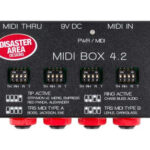
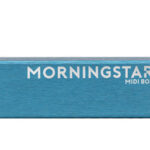
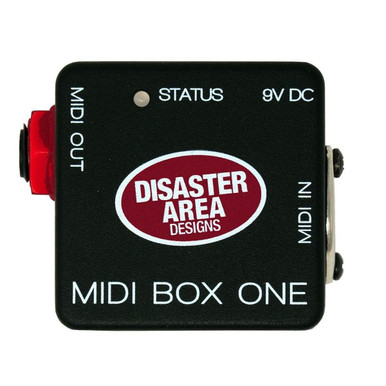
For players with only one MIDI pedal in their rig, the MIDI Box One is a handy way to convert a 5-pin MIDI input into a 1/4" output. The MIDI Box One features external dip switches to expand its compatibility to suit a range of MIDI-enabled pedals.
The MIDI Box One allows you to hook up a controller via a 5-pin connection and convert it to a 1/4" output for connecting to a MIDI-enabled pedal. On the underside is a set of dip switch which can be used to alter the configuration to match how different pedals receive MIDI. The dip switch settings are as follows:
- Tip Active: Suitable for Alexander Pedals, Meris, Empress Effects, and other devices using voltage mode on the jack tip.
- Ring Active: Suitable for Chase Bliss Audio and other devices using voltage mode on the jack ring.
- Tip and Ring Active: Separate outputs on the top and ring of the jack which allows for two MIDI outputs using a TRS insert cable.
Specifications
- Power: Requires 9-12v DC input, 50mA maximum.
- Status LED: Lights blue when powered, red when receiving MIDI data
- Dimensions: 51 mm x 51 mm x 27 mm (excluding jack nut)
Supported Devices
Chase Bliss Audio: All current pedals. Connect with TRS cable, set port to RING ACTIVE.
- Blooper
- Brothers
- Condor
- Dark World
- Gravitas
- MOOD
- Spectre (all versions)
- Thermae
- Tonal Recall (blue and RKM)
- Warped Vinyl Mk1 (supports MIDI clock only)
- Warped Vinyl Mk2 and HiFi
- Wombtone Mk1 (supports MIDI clock only)
- Wombtone Mk2
Alexander Pedals: All Neo Series pedals. Connect with mono / TS cable. Set port to TIP ACTIVE.
- Colour Theory
- Defender
- F.13 Neo
- Marshmallow
- Quadrant
- Radical Delay DX
- Sky 5000
- Space Race
- Super Neo-Matic
- Superball
- Syntax Error
- Wavelength
Empress Effects: Connect with mono / TS cable. Set port to TIP ACTIVE.
- Echosystem
- Phaser
- Tremolo 2
- Reverb
- ZOIA
Meris: All current pedals. Connect with mono / TS cable. Set port to TIP ACTIVE.
- Enzo
- Hedra
- Mercury 7
- Ottobit Jr
- Polymoon
Bondi Effects: Connect with mono / TS cable. Set port to TIP ACTIVE.
- Art Van Delay