JHS 3 Series Tape Delay Pedal

Retailing in the region of £99.99

The JHS Guitar Pedals always come out on top. This is New is in stock and ready to post out to you, with fast, reliable delivery straight to your door. For more New Guitar Pedals options, read on for full specifications, demos, and secure online ordering. The JHS Pedals 3 Series is a collection of pedals designed to give you affordability and simplicity without compromising quality. Each pedal has three simple controls and one toggle that offer a wide range of sounds, perfect for beginners and professionals alike. The JHS Pedals 3 Series will inspire your playing and help you…

View more in
Tags: , ,
View more by

As an affiliate partner, we may earn a small commission when you buy through our links — at no extra cost to you.


Description

The JHS Guitar Pedals always come out on top. This is New is in stock and ready to post out to you, with fast, reliable delivery straight to your door. For more New Guitar Pedals options, read on for full specifications, demos, and secure online ordering.

The JHS Pedals 3 Series is a collection of pedals designed to give you affordability and simplicity without compromising quality. Each pedal has three simple controls and one toggle that offer a wide range of sounds, perfect for beginners and professionals alike. The JHS Pedals 3 Series will inspire your playing and help you explore new sounds at a totally approachable price point.

The Evolution Of The Tape Delay

Tape delay was invented in the late 40s when Les Paul strung two Ampex Model 200A reel-to-reel tape recorders together. A little later, in 1953, Ray Butts invented the Echosonic, the first actual tape delay unit. This would be followed up by the Echoplex EP-1 in 1961 from Mike Battle and the Space Echo from Roland in 1974. The JHS Pedals 3 Series Tape Delay is a simplified and faithful throwback to these classic units. 

Dial In Stunning Tone

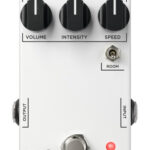
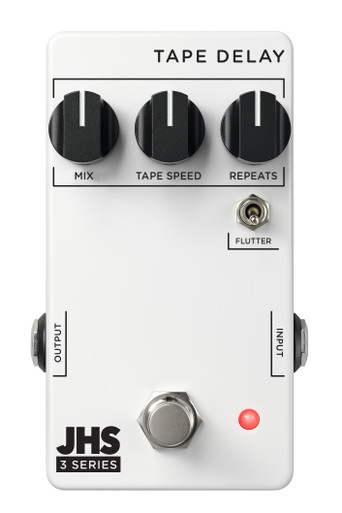
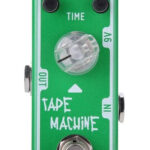
The Mix control lets you control how much clean signal is blended in with the wet (delayed) signal (on the original unit, this was called Echo Volume). Tape Speed acts as a simulation of the RE-201’s tape motor speeding up and slowing down and determines how short or long the delay effect is. The Repeats control goes from a single repeat to many, reminiscent of a sound being written onto the tape loop with loss of fidelity each time. Finally, when the Flutter toggle is turned on (up position), it replicates the wear & tear to the mechanical parts of a tape machine that happens over time. This causes mild modulation, warble, and flutter sounds in the echo path of the delay that so many players desire.

Controls

  • MIX – Controls how much clean signal is blended in with the wet (delayed) signal. Left is more dry signal. Right is more wet signal.
  • TAPE SPEED – Controls the length of delay effect. Left is shorter. Right is longer.
  • REPEATS – Controls how many repeats occur after you play. Left is less. Right is more.
  • FLUTTER – Switch down is standard effect. Switch up introduces a mild modulation reminiscent of vintage units with mechanical wear.

Specifications

  • INPUT – ¼” jack on the right side of the pedal.
  • OUTPUT – ¼” jack on the left side of the pedal.
  • POWER – Requires 9VDC negative center power and consumes 65mA. Not not use more than 9VDC. You will void your warranty.
 

Additional information

Weight 0.5 kg

About the manufacturer

JHS

JHS is a boutique effects brand known as JHS Pedals, recognised for producing reliable, great-sounding pedals that range from simple, classic designs to more experimental and feature-rich effects. Their pedals often focus on clarity, musical usability and thoughtful circuit design, making them popular with players across many genres. Understanding pedal purpose, control layout and how JHS pedals interact with amps and other effects helps players get the most from them on both pedalboards and in the studio.

More info about this Product

Guitar Pedals

Guitar pedals are compact effects units that shape and enhance a guitar’s sound, sitting between the instrument and the amplifier. They include gain pedals like overdrive and distortion, modulation effects such as chorus and tremolo, time-based effects like delay and reverb, and essential utilities including tuners, compressors and loopers. Understanding basic things such as pedal type, signal order, power requirements and intended use helps players choose pedals that suit their style, setup and playing environment.

More Gear like this

Delay

Delay is an effect that records the guitar signal and plays it back after a short period of time, creating an echo or repeat. By adjusting the time, feedback, and level, delay can add subtle depth and space or produce rhythmic, expressive repeats that enhance lead lines, ambient textures, and overall atmosphere.

Pedal

Pedals are the tools that let you shape, colour and transform your sound, from subtle tone enhancement to bold, creative effects. Whether you are adding grit, space, movement or control, a pedal becomes part of your playing rather than just an add-on. Exploring different pedals is about discovering what responds to your touch and helps your sound feel more like your own.

Tape

Tape refers to effects and recording techniques based on analogue magnetic tape machines, known for their warm, slightly compressed, and organic sound. Tape-based effects often introduce subtle saturation, natural roll-off in the high frequencies, and gentle modulation that adds character and depth.

In guitar and studio gear, tape is most commonly associated with echo and delay effects, where the repeats have a soft, evolving quality. Tape-style sounds are valued for their musical imperfections and vintage feel, and are widely used in rock, ambient, dub, and experimental music.

Related gear

Available for Amazon Prime